
What Is Head and Neck Cancer?
Head and neck cancer is a group of cancers that start in your mouth, throat, voice box, nose, or sinuses. These are the parts of your body you use to breathe, eat, talk, and smell. Head and neck cancer is the seventh most common cancer in the world1.
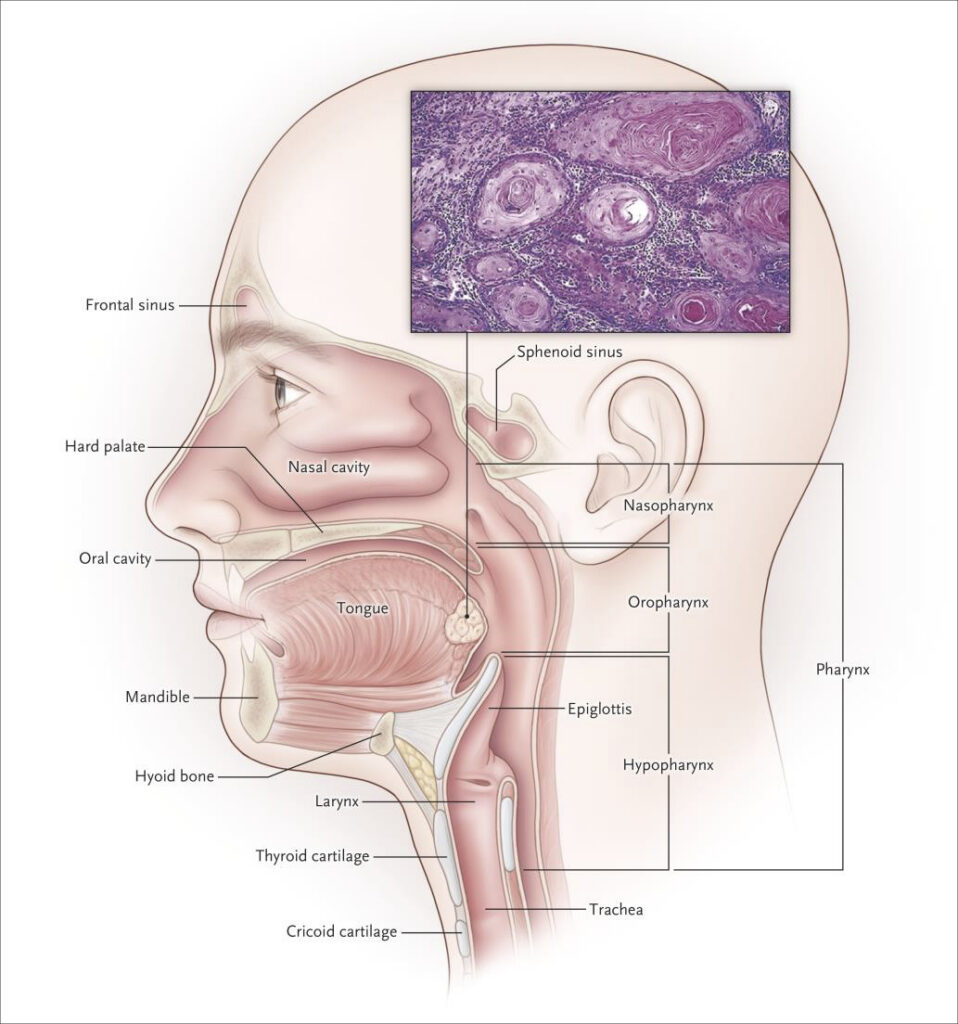
Head and neck cancers can happen in different places1,2,3:
- Mouth (oral cavity): Your lips, tongue, gums, and inside of your cheeks
- Throat (pharynx): The tube that goes from your nose and mouth down to your stomach and lungs. This includes your tonsils.
- Voice box (larynx): The part of your throat that helps you talk
- Nose and sinuses: The space behind your nose and the air pockets around your nose
- Salivary glands: The glands in your mouth that make spit The picture below shows where these cancers can grow:
The picture below shows where these cancers can grow:
What Causes Head and Neck Cancer?
The main things that can cause head and neck cancer are1,2,5
- Smoking: Smoking cigarettes, cigars, or pipes is one of the biggest causes of head and neck cancer. Chewing tobacco also causes cancer.
- Drinking alcohol: Drinking a lot of alcohol can cause head and neck cancer. If you smoke AND drink alcohol, your risk is much higher than doing just one.
- HPV virus: HPV (human papillomavirus) is now the main cause of throat cancer in many countries. This is the same virus that can cause cervical cancer in women. You can get HPV in your throat from oral sex. Throat cancers caused by HPV are becoming more common, especially in younger people
- Other viruses: A virus called EBV (Epstein-Barr virus) can cause cancer in the back of your nose.
Other things that can increase your risk1:
- Being older (most people are around 60 years old when they get head and neck cancer)
- Being male (men get it more than women)
- Not eating enough fruits and vegetables
- Chewing betel nut (common in some Asian countries)
- Having radiation treatment to your head or neck before
- Having a weak immune system
What Are the Signs of Head and Neck Cancer?
You should see a doctor if you have any of these problems for more than two weeks:1,6,7,8
Common signs include:
- A lump in your neck
- A sore in your mouth or throat that won’t heal
- Sore throat that won’t go away
- Trouble swallowing or pain when you swallow
- Your voice sounds different or hoarse
- Ear pain
- Losing weight without trying
- White or red patches in your mouth
- Bleeding from your mouth or nose
- Stuffy nose that won’t clear up
- Nosebleeds that happen a lot
- Trouble breathing
- Numbness in your face or mouth
Important: Many people with HPV throat cancer first notice a lump in their neck. People without HPV more often have pain or sores in their throat.9
How Do Doctors Find Out If You Have Head and Neck Cancer? 1,10
If your doctor thinks you might have cancer, you will need some tests:
- Physical exam: Your doctor will look in your mouth and throat and feel your neck. The doctor may use a small camera to look down your throat
- Biopsy: The doctor takes a tiny piece of tissue to look at under a microscope. This is the only way to know for sure if you have cancer.
- HPV test: For throat cancers, doctors test to see if HPV caused the cancer. This is important because it helps decide your treatment.
Scans:
- CT scan: A special X-ray that takes detailed pictures
- MRI: Uses magnets to take pictures of your body
- PET scan: Shows where cancer cells are in your body
- Chest CT: Checks if cancer has spread to your lungs
Other tests you may need:
- Dental checkup
- Nutrition checkup
- Speech and swallowing checkup
- Hearing test
- Help to quit smoking
What Is Staging?
After you are diagnosed, your doctor will find out the “stage” of your cancer. The stage tells how big the cancer is and if it has spread. Stages go from I (early) to IV (advanced).1
For HPV throat cancer, there is a different staging system because these cancers usually respond better to treatment than cancers not caused by HPV10
What Is the Outlook? 1,2
How well you do depends on:
- Where the cancer is
- What stage it is
- If HPV caused it (for throat cancers)
- Your overall health
- If you smoke or drink alcohol
HPV throat cancers usually have a much better outlook than cancers not caused by HPV. People with HPV throat cancer are about 58% less likely to die from their cancer.
How Is Head and Neck Cancer Treated? 1,2,5
Treatment depends on where your cancer is, what stage it is, and your overall health. Most people need a team of doctors and care providers.
Treatment options include:
Surgery:
- For mouth cancers, surgery is usually done first. You may need radiation after surgery.
- Surgery removes the cancer and sometimes lymph nodes in your neck
- Some surgeries can be done with a robot or laser
- You may need surgery to rebuild parts of your mouth or throat
Radiation therapy:
- Uses high-energy beams to kill cancer cells
- For throat and voice box cancers, radiation is often used instead of surgery to help you keep your ability to talk and swallow
- Usually given 5 days a week for 6-7 weeks
Chemotherapy:
- Uses medicine to kill cancer cells
- The most common chemotherapy drug is called cisplatin
- May be given before, during, or after other treatments
Immunotherapy:
- Newer treatments that help your immune system fight cancer
- Used for cancer that has come back or spread
After surgery, you may need more treatment if:
- The cancer wasn’t completely removed
- Cancer spread outside the lymph nodes
- Many lymph nodes had cancer
- The cancer grew into nerves or blood vessels
Very advanced or cancer that has spread:
- May be treated with chemotherapy, immunotherapy, or both
- Radiation may be used to help with symptoms
What Are the Side Effects of Treatment?
Treatment can cause problems both during and after treatment, here are some but not all of the possible side effects:
Surgery side effects:
- Changes in how you look
- Trouble talking or swallowing
- May need a feeding tube
- Scars
Radiation side effects:
- Dry mouth
- Trouble swallowing
- Skin changes
- Changes in taste
- Tooth problems
- Feeling tired
- May need a feeding tube
Chemotherapy side effects:
- Feeling sick to your stomach
- Hearing loss (with cisplatin)
- Kidney problems
- Low blood counts
- Feeling tired
Your doctors will help you manage these side effects.
What Happens After Treatment?10
After treatment, you will need regular checkups to make sure the cancer doesn’t come back and to help with any side effects. Follow-up includes:
- Physical exams
- Scans as needed
- Checking your speech and swallowing
- Dental care
- Managing side effects
Can Head and Neck Cancer Be Prevented?1,2
You can lower your risk of head and neck cancer by:
Quit smoking: This is the most important thing you can do. Ask your doctor for help quitting.
Limit alcohol: Drink less or stop drinking alcohol.
Get the HPV vaccine: The HPV vaccine can prevent HPV infection and may lower your risk of throat cancer.
Take care of your teeth: See your dentist regularly.
Eat healthy: Eat lots of fruits and vegetables.
Important Things to Remember
- Head and neck cancer includes cancers of the mouth, throat, voice box, nose, and sinuses
- The main causes are smoking, alcohol, and HPV virus
- HPV throat cancers usually respond better to treatment than cancers not caused by HPV
- Treatment usually includes surgery, radiation, chemotherapy, or a combination
- See your doctor if you have symptoms lasting more than two weeks
- Quitting smoking and limiting alcohol can lower your risk
- Regular checkups after treatment are very important
References
- Head and Neck Cancer. Mody MD, Rocco JW, Yom SS, Haddad RI, Saba NF. Lancet (London, England). 2021;398(10318):2289-2299. doi:10.1016/S0140-6736(21)01550-6.
-
Head and Neck Squamous Cell Carcinoma. Johnson DE, Burtness B, Leemans CR, et al. Nature Reviews. Disease Primers. 2020;6(1):92. doi:10.1038/s41572-020-00224-3.
-
Head and Neck Cancer: Current Challenges and Future Perspectives. Bhat GR, Hyole RG, Li J. Advances in Cancer Research. 2021;152:67-102. doi:10.1016/bs.acr.2021.05.002.
-
Head and Neck Cancer. Chow LQM. The New England Journal of Medicine. 2020;382(1):60-72. doi:10.1056/NEJMra1715715.
-
Head and Neck Squamous Cell Carcinoma: Update on Epidemiology, Diagnosis, and Treatment. Marur S, Forastiere AA. Mayo Clinic Proceedings. 2016;91(3):386-96. doi:10.1016/j.mayocp.2015.12.017.
-
Diagnosis and Management of Squamous Cell Carcinoma of Unknown Primary in the Head and Neck: ASCO Guideline. Maghami E, Ismaila N, Alvarez A, et al. Journal of Clinical Oncology : Official Journal of the American Society of Clinical Oncology. 2020;38(22):2570-2596. doi:10.1200/JCO.20.00275.
-
American Cancer Society Head and Neck Cancer Survivorship Care Guideline. Cohen EE, LaMonte SJ, Erb NL, et al. CA: A Cancer Journal for Clinicians. 2016;66(3):203-39. doi:10.3322/caac.21343.
-
Clinical Practice Guideline: Evaluation of the Neck Mass in Adults. Pynnonen MA, Gillespie MB, Roman B, et al. Otolaryngology–Head and Neck Surgery : Official Journal of American Academy of Otolaryngology-Head and Neck Surgery. 2017;157(2_suppl):S1-S30. doi:10.1177/0194599817722550.
-
Initial Symptoms in Patients With HPV-Positive and HPV-Negative Oropharyngeal Cancer. McIlwain WR, Sood AJ, Nguyen SA, Day TA. JAMA Otolaryngology– Head & Neck Surgery. 2014;140(5):441-7. doi:10.1001/jamaoto.2014.141.
-
Head and Neck Cancers. National Comprehensive Cancer Network Updated 2025-12-08